Given our fragile global order, it’s impossible not to wonder whether the concept of “collective security” has died. The answer depends on what we mean by the term. If collective security means a system in which the world’s major powers renounce using force to alter the status quo and agree to unite to stop any country that violates this pledge, then it is not dead for one simple reason: It was never alive.
The traditional version of collective security—best illustrated by the League of Nations founded after World War I—seeks to transcend power politics by committing states to settle their differences peacefully and to work together to stop any country that violates this principle. Unfortunately, this assumes that dangerous aggressors will be easy to identify and that all the other states will agree on who they are. It further assumes that all the major powers will be willing to act together to stop a powerful aggressor—which is costly and dangerous—even when their own interests are not directly involved. Inevitably, some will be tempted to stand aside and let others deal with the problem. This vision of collective security depends, in short, on a level of trust and selflessness that is rare to non-existent in world politics.
Given our fragile global order, it’s impossible not to wonder whether the concept of “collective security” has died. The answer depends on what we mean by the term. If collective security means a system in which the world’s major powers renounce using force to alter the status quo and agree to unite to stop any country that violates this pledge, then it is not dead for one simple reason: It was never alive.
The traditional version of collective security—best illustrated by the League of Nations founded after World War I—seeks to transcend power politics by committing states to settle their differences peacefully and to work together to stop any country that violates this principle. Unfortunately, this assumes that dangerous aggressors will be easy to identify and that all the other states will agree on who they are. It further assumes that all the major powers will be willing to act together to stop a powerful aggressor—which is costly and dangerous—even when their own interests are not directly involved. Inevitably, some will be tempted to stand aside and let others deal with the problem. This vision of collective security depends, in short, on a level of trust and selflessness that is rare to non-existent in world politics.
But there is another way of defining collective security—namely, as agreements intended to make war less likely or as military alliances where a subset of states join forces to deter or defeat a common threat. History offers many such examples. Unfortunately, even these more modest forms of collective security are not that effective and are becoming less so, which will make the world of the future more dangerous than the recent past.
Even so, the relatively realistic collective security arrangements that have existed in the past deserve deeper consideration today—if only to understand why they are now on life support.
One limited form of a collective security arrangement is a “security regime,” where rivals agree to limit their competition in narrow and specific ways. Arms control agreements such as the SALT and START treaties are good examples, and some of these measures did help reduce the risk of war slightly. But these agreements did not stop the superpowers from building thousands of nuclear weapons or spending billions of dollars to make them more lethal. Nor did they end the bitter rivalry between the Soviet Union and the West.
Prospects for arms control agreements of this kind are not bright today, in part because the number of states that must participate has grown. The world is now multipolar, not bipolar, as it was during the Cold War, which means China must be included to make arms control among the great powers work. No effort is being made to hammer out an arms control agreement involving Beijing, Moscow, and Washington, and China is not interested in limiting arms until it catches up with the other two. Instead, China and some other states are increasing their nuclear arsenals; Russia and the United States are modernizing their own forces in response; and several other countries are considering acquiring nuclear forces of their own. Efforts to create guardrails around artificial intelligence or cyberweapons have gone nowhere, which is hardly surprising, given that getting all the relevant countries to agree on meaningful limits would be a formidable task.
A second limited form of collective security is peacekeeping. Once two or more warring parties have decided to make peace, neutral peacekeepers are deployed to monitor the agreement and reassure each side. But notice that this scheme only works if the groups that were previously at war genuinely want to stop fighting and stick with that decision because peacekeepers are usually too weak to stop a state or a warlord who decides to take up arms again. Peacekeeping is a useful tool, but it cannot prevent war by itself.
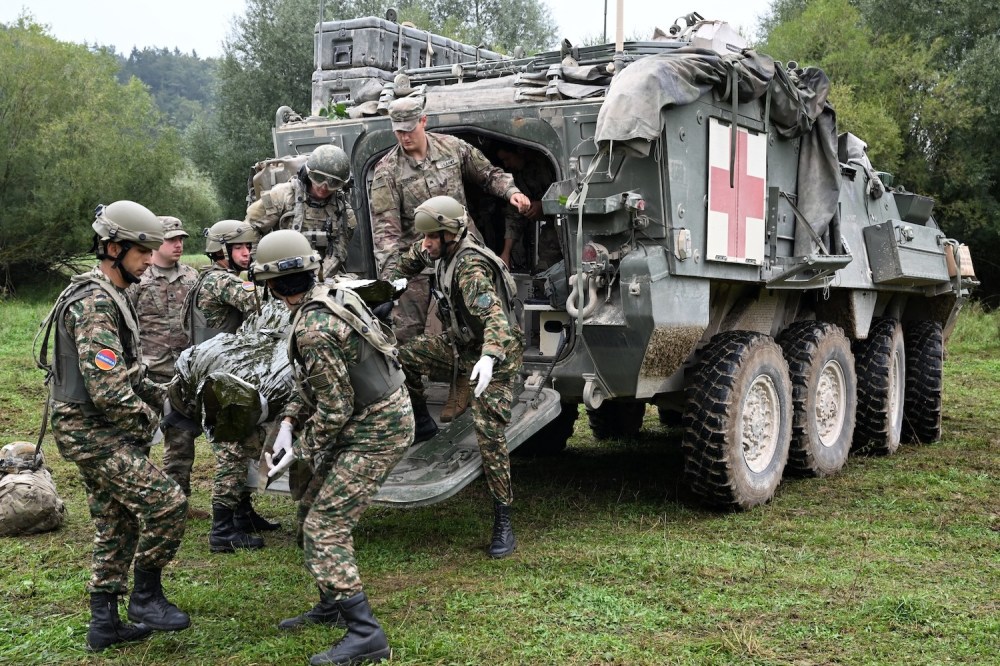
The final and most effective form of collective security—which is more accurately described as “collective defense”—is a military alliance. States facing a common threat can make themselves more secure by agreeing to help defend one another and coordinating their military preparations to deter a threatening state from attacking them or to defeat it if it does. Alliances are most likely to form when a powerful and well-armed state is nearby and it appears willing to use force to alter the status quo. In that situation, the threat posed by the potential aggressor will be clear to others and give them ample reason to unite against the danger. That logic explains why NATO formed in 1949; why the United States allied with Japan, South Korea, and other Asian states during the Cold War; and why a large coalition came together to evict Iraq from Kuwait in the first Gulf War.
The tendency for states to join forces against external threats can also be seen in the way that the United States and much of Europe rallied to support Ukraine after Russia invaded in February 2022. But it also explains why China and North Korea have given Russia considerable support as that war has dragged on. The Ukraine case also reminds us that collective defense arrangements do not always prevent war because deterrence sometimes fails.
Collective defense arrangements worked very well during the Cold War because it was clear to both sides that the use of force in Europe would lead to a vast and destructive war between two powerful alliances. Given that disastrous prospect, both sides wisely chose not to fight.
Unfortunately, we cannot count on similar predictability and stability today because there is much less consensus on which states pose the greatest threats or how best to respond to them. In Europe, for example, some states see Russia as a relentless aggressor seeking to rebuild its former empire and dominate the European continent, while others do not share this alarmist view. Most states in the global south do not fear Russia and continue to do business with Moscow, and the Trump administration’s position on Russia seems to change from week to week. I would also remind you that even though NATO still insists that Ukraine will join someday, no NATO members have been willing to send their own soldiers to fight and die for Ukraine.
Moreover, U.S. policymakers are increasingly convinced that Europe should be responsible for its own security so that Washington can focus on containing Chinese power in Asia. Europeans sometimes talk about playing a strategic role in the Indo-Pacific region, but no European country has the military capabilities to make a difference there. Nor do they have a vital interest in doing so. What this means is that U.S. and European strategic interests are diverging, which will inevitably weaken NATO even if the alliance remains formally intact.
China’s rising power and ambitions are apparent to its Asian neighbors, however, and obviously to the United States. Nevertheless, efforts to form a balancing coalition have been impeded by erratic U.S. policies toward the region; by the desire to stay friendly with China because of its importance to many Asian economies; by rivalries among different Asian powers; and by each state’s desire to get others to do the heavy lifting against China while they sit on the sidelines. The result is growing uncertainty about who will do what in a crisis, which makes miscalculation more likely. It is entirely possible that Australia, Japan, the United States, and some others would come to Taiwan’s aid in the event of a Chinese attack, for example, but it is also possible that some or all of them would stand aside. In short, while there is a balancing coalition in Asia aimed at China, it may not have sufficient coherence and credibility to deter China from making a bid for regional hegemony.
Finally, although states create alliances primarily in response to external threats, these arrangements are stronger when states share similar values and especially the core values of liberal democracy. Unfortunately, the shared values that once united the West are evaporating. At the end of the Cold War, many people believed that liberal democracy was the wave of the future; instead, it has been in steady retreat for nearly two decades, as governments based on strongman rule have emerged in places such as Egypt, Hungary, India, Russia, Turkey, and, yes, perhaps even in the United States. Britain has left the European Union; Hungary and Slovakia oppose many of its principles; and the recently released White House National Security Strategy makes it abundantly clear that the Trump administration is actively hostile to the EU’s liberal principles and to many European governments.
Moreover, Europe and the United States are increasingly divided over what to do in the Middle East. The United States gave Israel more than $22 billion in additional military aid as it waged a genocidal campaign in Gaza. When the International Criminal Court (ICC) indicted Israeli Prime Minister Benjamin Netanyahu and former Defense Minister Yoav Gallant on war crimes charges, along with several Hamas leaders, the United States imposed sanctions on several ICC officials. By contrast, a growing number of European states, including Britain and Norway, have formally recognized the state of Palestine and pledged to hold Israeli officials accountable for war crimes. Where is the shared commitment to human rights or international justice in these different responses? It is also revealing that Britain, which has long been America’s closest ally and intelligence partner, recently suspended certain types of intelligence sharing with the United States because London did not want to be implicated in the Trump administration’s illegal and murderous attacks on small boats in the Caribbean. A small matter, perhaps, but another sign of diminishing agreement on what actions are legitimate or consistent with core Western values.
What I am suggesting, alas, is that shared values are not going to strengthen alliances made for balance-of-power reasons or help the member states overcome diverging strategic interests.
What conclusions should you draw from this admittedly pessimistic analysis? Let me suggest three. First, do not place your hopes for the future in the more ambitious version of collective security: It has never worked in the past and will not work in the future. Second, we continue to live in a world where individual states must rely on their own resources to survive and prosper, which is not to say they cannot improve their security by having reliable partners to help them deal with common dangers. It is the task of diplomacy to clarify what those dangers are and to build a broad consensus on how to respond; unfortunately, this sort of diplomacy is in short supply at present.
Third, strengthening one’s own capabilities and forming strong alliances does not preclude serious efforts to resolve existing conflicts, reduce tensions with rivals, or minimize specific risks—tasks best accomplished by having experienced and knowledgeable officials engage with adversaries in a disciplined and transparent way, rather than via backroom deals conducted by amateurs.
But make no mistake: Even the more realistic approaches to collective security will not eliminate the risk of war or the need for states to prepare for that possibility. Collective security may not be dead, but it is certainly not in good health.
This essay is adapted from opening remarks delivered at the 2025 Holberg Debate in Bergen, Norway, on Dec. 9. The other speakers were former British Prime Minister Boris Johnson and Mary Kaldor of the London School of Economics; the event was moderated by Stephen Sackur. A video of the 2025 Holberg Debate can be found here.


