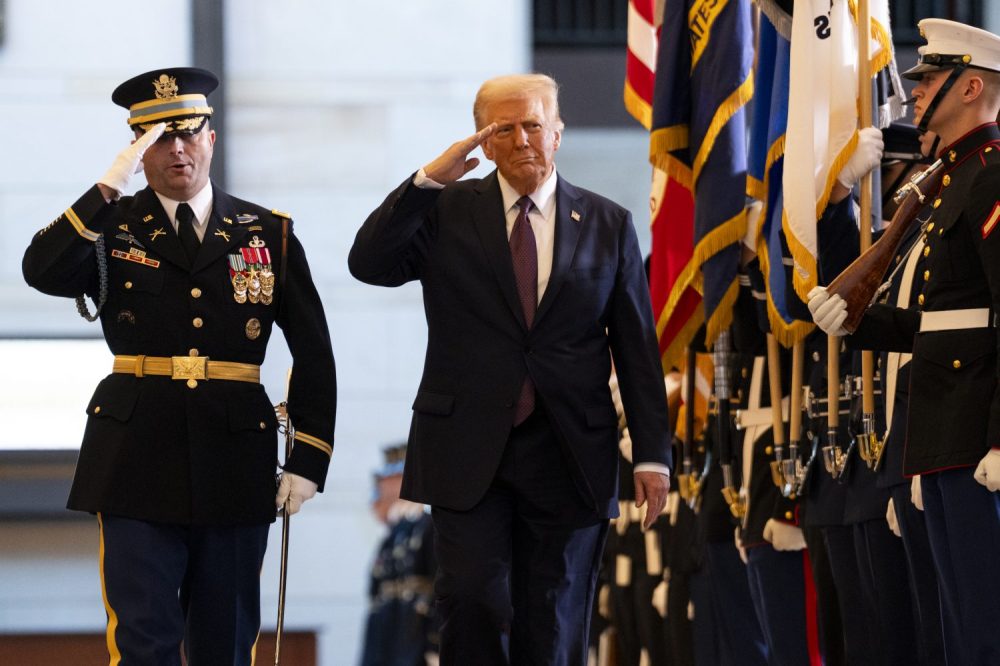
When U.S. President Donald Trump arrived at Joint Base Elmendorf-Richardson last summer to meet with Russian President Vladimir Putin, political pundits took notice of the symbolic choice of venue. Alaska, a former Russian territory sold to the United States during friendlier times, represented both a historic and geographic bridge between the two powers. Siberia lies just 55 miles away across the Bering Strait, and, to this day, many Alaska Natives share more in common with its indigenous Chukchi people than with the average American. Yet the sea ice, remote villages, and snow-capped mountains that define the so-called Last Frontier were far removed from Trump’s visit to the military installation in Anchorage. With a low-hanging cloud bank shrouding the horizon, it’s likely Trump never even glimpsed the summit of Mount McKinley—the Denali peak he controversially renamed last year—before returning home to the Lower 48 and the manicured golf courses that are the antithesis of Alaska’s rugged wilderness.
Since he first took office in 2017, Trump has made few visits to this remote outpost of his domain. He had last traveled to the state in 2022 for a rally ahead of his reelection bid. Previous trips advertised as presidential visits coincided with refueling stopovers on flights to and from Asia. In total, Trump has made just five official visits to Alaska—compared with 21 to Florida in 2025 alone.
When U.S. President Donald Trump arrived at Joint Base Elmendorf-Richardson last summer to meet with Russian President Vladimir Putin, political pundits took notice of the symbolic choice of venue. Alaska, a former Russian territory sold to the United States during friendlier times, represented both a historic and geographic bridge between the two powers. Siberia lies just 55 miles away across the Bering Strait, and, to this day, many Alaska Natives share more in common with its indigenous Chukchi people than with the average American. Yet the sea ice, remote villages, and snow-capped mountains that define the so-called Last Frontier were far removed from Trump’s visit to the military installation in Anchorage. With a low-hanging cloud bank shrouding the horizon, it’s likely Trump never even glimpsed the summit of Mount McKinley—the Denali peak he controversially renamed last year—before returning home to the Lower 48 and the manicured golf courses that are the antithesis of Alaska’s rugged wilderness.
Reluctant Conquest: American Wealth, Power, and Science in the Arctic, Kathryn C. Lavelle, Yale University Press, 368 pp., $50, June 2025
Since he first took office in 2017, Trump has made few visits to this remote outpost of his domain. He had last traveled to the state in 2022 for a rally ahead of his reelection bid. Previous trips advertised as presidential visits coincided with refueling stopovers on flights to and from Asia. In total, Trump has made just five official visits to Alaska—compared with 21 to Florida in 2025 alone.
Trump’s seeming indifference to the 49th state fits comfortably with historic U.S. attitudes toward the far north. Barack Obama became the first sitting U.S. president to set foot above the Arctic Circle, the northerly latitude beyond which the sun does not set on the summer solstice, back in 2015—nearly 150 years after the Alaska Purchase. He remains the only U.S. president to have done so, despite the rapid, destabilizing warming of the region. Such detachment all but defines the history of U.S. engagement in the Arctic, as political scientist Kathyrn C. Lavelle writes in her new book, Reluctant Conquest: American Wealth, Power and Science in the Arctic.
Only now is that beginning to change. In recent years, the Arctic has become a strategic heavyweight in the race to extract resources and build up northern defenses. And the U.S. approach to the region has evolved rapidly in the first few weeks of 2026, with the Trump administration focusing its attention on bringing Greenland, an autonomous territory of Denmark, under its domain. (Trump has never visited Greenland either.)
Lavelle’s sweeping study of history, beginning with the American Revolution and ending with the final year of the Biden administration, is invaluable to understanding where Trump’s fixation fits into the trajectory of U.S. policy. Her thinking around the subject revolves around a singular question: Why has the Arctic failed to play a pivotal role in crafting the national identity of the United States—unlike in Russia, Iceland, Finland, Sweden, Denmark, Norway, and Canada? Most Americans, she argues, do not think of their country as an Arctic nation. “(T)he U.S. is considered a ‘reluctant’ Arctic power and does not always recognize it as part of its sense of self,” Lavelle writes. The question now is whether Trump will succeed in changing that.

The oil tanker Arco Sag River at the Alaska Oil Pipeline terminal on March 28, 1989. Christopher Wilkins/AFP via Getty Images
The acquisition of Alaska came to be considered one of history’s best deals only a few decades after its purchase. In 1867, U.S. Secretary of State William H. Seward negotiated the transfer from Russia for just $7.2 million—around $150 million today. Russia was willing to cut such a bargain, Lavelle writes, due in part to fears that the territory would fall into Britain’s hands, which Russia hoped to avoid by quickly offloading the icy parcel of land.
The deal proved its worth—and then some—beginning in 1896, when gold was discovered in Canada’s Klondike region, close to the Alaska border, kicking off a gold rush in Alaska’s remote wilderness. Yet it took until World War II, when Alaska served as a vital buffer zone and pathway for transferring aircraft to the Soviet Union, for Washington to fully understand just how valuable the purchase was.
“In the future, whoever holds Alaska will hold the world,” Gen. Billy Mitchell, a pioneer of the U.S. Air Force, told Congress in 1935, stressing the territory’s strategic location as a northern air route and defensive position. The arrival of the Cold War with the Soviet Union would cement Mitchell’s point. Alaska provided the first line of defense, since the shortest and likeliest route of attack on the United States would be via Siberia. The state, then known as the “Guardian of the North,” served as a major military staging area.
The Cold War also meant that, rather than simply thinking about Alaska in domestic terms, the U.S. government needed to frame the state in the context of foreign relations—especially on the basis of oil, security, and the environment. Lavelle argues that U.S. Arctic policy has been “intertwined with foreign relations since the country was founded.” In general, she writes, this policy area has swung between isolationism and internationalism depending on competing priorities, from wars in the Middle East to perceived threats from China. At the same time, the Arctic’s importance to U.S. national security has “ebbed and flowed in American history alongside the global balance of power.”
Scientific interest in the Arctic region, however, has remained a near-constant—sometimes bolstering security measures while at other times providing a pathway for peaceful cooperation between nations. Research expeditions into the U.S. Arctic took off in the late 1800s, and since then, the United States has established a number of agencies, including the National Oceanic and Atmospheric Administration and the National Science Foundation, that have supported Arctic research. The region offers a unique vantage point, Lavelle argues, in understanding how the U.S. government has handled global environmental issues over time—particularly human-caused climate change, which is warming the Arctic nearly four times faster than the rest of the world. As polar ice melts, the Arctic is being reshaped both geographically and politically.

A map of the Arctic Circle, circa 1902, with Alaska at top-center left.The Print Collector/Getty Images
Reluctant Conquest is at its best when delving into the recent history of U.S. relations in the Arctic, moving beyond the 49th state to consider multilateralism in the region, underpinned by the concept of a “circumpolar Arctic,” which acknowledges the shared traits of northern countries and serves as a key organizing principle for international policy. This idea was backed by postwar scientific research recognizing that northern regions around the globe share many ecological similarities, from glaciers to permafrost. This perspective was later consolidated by the 1996 formation of the Arctic Council, an intergovernmental forum between the eight nations with territory above the Arctic Circle: Norway, Finland, Sweden, Iceland, Denmark, Russia, Canada, and the United States. While the book considers relations between the United States and the Nordics as well as Canada, it almost always returns to the unstable dynamics between Russia and the United States, where the Arctic oscillates between serving as a bridge and a divide.
“When the Cold War ended, the U.S. and its rival, Russia, had to reorient themselves in world politics,” Lavelle writes. After Mikhail Gorbachev took over as head of the Soviet Communist Party, he proposed a radical transformation for the region that would define Arctic relations for decades to come. In an October 1987 speech in the far northwestern Russian city of Murmansk, Gorbachev proposed the Arctic should move from a military theater to a “zone of peace.” Arctic powers, in his vision, would disarm nuclear weapons and establish an East-West dialogue while bolstering environmental cooperation. Though the United States and other Arctic states were suspicious of Gorbachev’s push for demilitarization, believing such measures would disproportionately benefit the Soviet Union, they rallied behind his calls for greater scientific collaboration.
After Gorbachev was ousted from power in 1991, his vision for the Arctic remained, giving rise among academics to the idea of “Arctic exceptionalism,” which holds that the far north is a unique region with a history and a set of unwritten rules that can insulate it from broader global conflicts. Still, Washington was at times skeptical. When Canada pushed to establish a formal international organization on Arctic affairs in the early 1990s, the United States showed little enthusiasm. Eventually, though, the Clinton administration supported the creation of the Arctic Council, seeing value in its ability to discuss common environmental issues, and would later put the council’s work at the center of its engagement in the region.
In the 2010s, the council landed three legally binding agreements on scientific cooperation, search and rescue, and oil pollution preparedness and response in the Arctic. But above all, the council’s success is best seen in its ability to keep the Arctic as a zone of peaceful, non-militarized cooperation into the 21st century—as Gorbachev once dreamed.

U.S. Army Special Forces and troops from the Danish Jaeger Corps learn how to load and unload snowmobiles for transport on a CH-47G Chinook at the Yukon Training Area at Fort Wainwright military base in North Pole, Alaska, on Feb. 23, 2024. Salwan Georges/The Washington Post via Getty Images
The Arctic has arguably entered a new chapter in the last three years. Russia’s 2022 invasion of Ukraine spurred the Arctic Council to suspend its activities, though slowly some council work—including responding to climate change and monitoring ecosystems—has resumed. Sweden and Finland’s accession to NATO has further stressed relations with Russia. It’s unclear how the new geopolitical feud between Denmark and the United States will impact the already tenuous existence of the Arctic Council.
“Severe strains placed on the security structure of the wider world were also bound to wear down Arctic relations since they can never be completely divorced from more traditional economic and military concerns,” Lavelle asserts in her book.
Trump’s reelection has also marked the end of liberal internationalism for the time being. The United States has pulled out of international agreements and pivoted away from climate and environmental science. Last year, the U.S. Arctic Research Commission, an independent federal agency, released a report on its regional priorities that emphasized military, economic, and energy security. It does not mention climate change. Later this year, Washington is expected to publish its five-year national Arctic research plan. Experts say it is likely to focus on national security—harkening back to the Reagan administration, which similarly prized national security and resource and energy development in the Arctic.
The greatest development in U.S. Arctic policy in the coming years will presumably be its position on Greenland. Reluctant Conquest, completed before Trump’s second term, briefly touches on Trump’s desire to obtain the self-ruling Danish territory back in 2019, but quickly dismisses it: “The suggestion fell flat in the world community,” Lavelle writes.
In recent months, however, Trump has been much more vocal about his designs on Greenland. Still, he has said he won’t use military force to obtain the ice-covered island, which lies closer to North America than it does to Europe. And, for now at least, he has scrapped the tariffs he planned to impose on eight European nations to press for control. Danish Prime Minister Mette Frederiksen has said that any U.S. attack on Greenland would spur the end of NATO.
With dozens of armchair Arctic diplomacy experts cropping up seemingly overnight, Reluctant Conquest stands as an authoritative and timely read for those seeking to understand Trump’s sudden fixation with Greenland and why the Arctic is no longer a U.S. afterthought. Lavelle expertly unravels the sequence of events across time and space that led to what some have described as a “scramble for the Arctic.” In doing so, she captures the spirit of Arctic relations, which ultimately “embody opposing elements of sincere cooperation and profound conflict.”