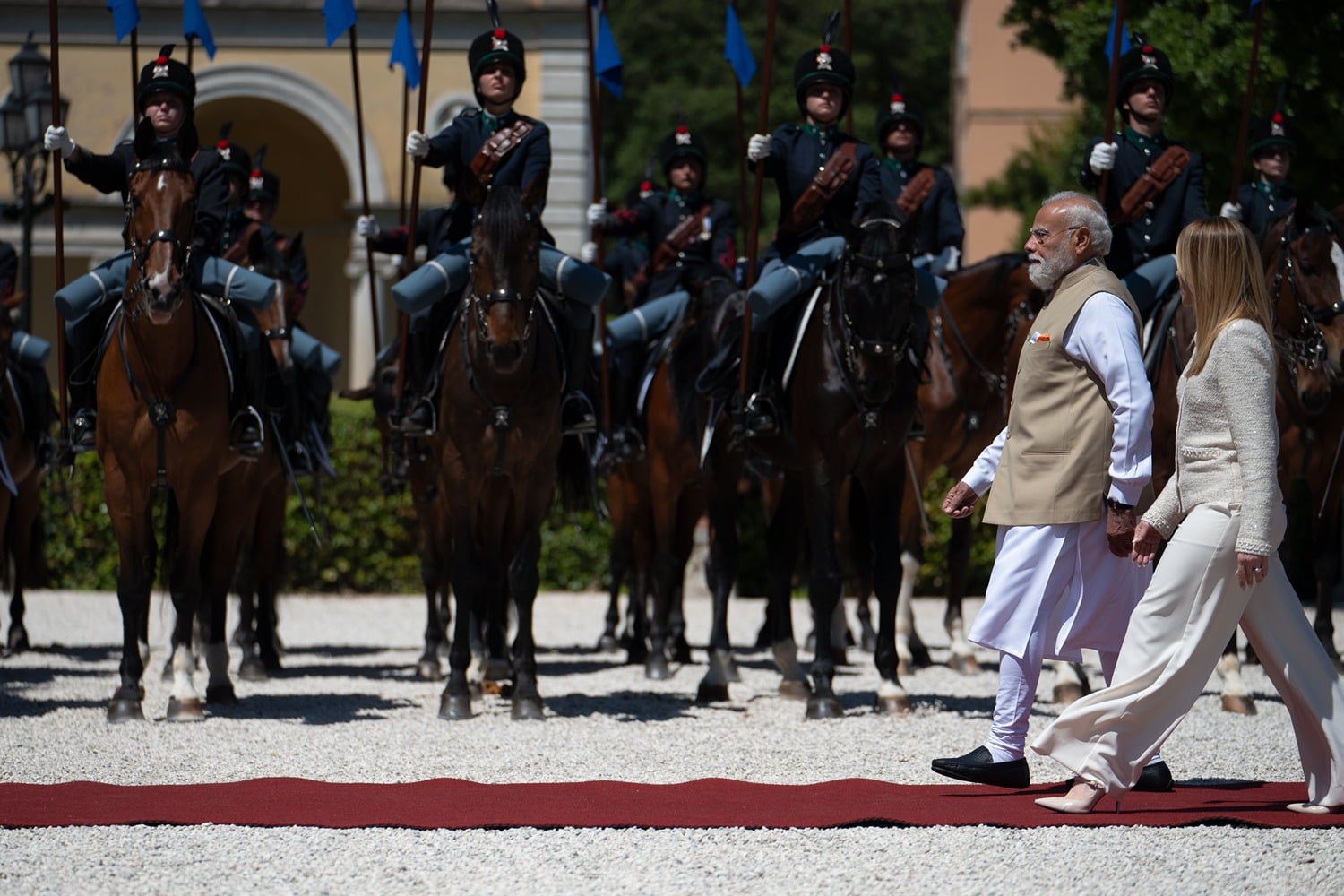
Indian Prime Minister Narendra Modi’s recent European tour, which included stopovers in Italy, Netherlands, Norway, and Sweden as well as participation in the India-Nordic Summit, has revived platitudes about the world’s largest democracy. Almost every joint statement between India and a Western country acknowledges both countries’ common democratic heritage as the basis for deepening cooperation.
India has long been seen as a counterweight to China in its material heft. It is the world’s most populous country and on track to become the world’s third-largest economy by the end of this decade. But it is also seen as appealing because of its democratic values, which make it an alternative to China’s one-party techno-surveillance state.
New Delhi is not averse to leveraging this status, referring to itself as the “mother of democracy” and promoting global governance initiatives through the prism of its democratic credentials. Take India’s role as host during the Artificial Intelligence Impact Summit earlier this year, where the “democratization of AI” was a key theme. India’s democratic credentials are also the basis of its claim to be a “voice” of the global south as well as its ongoing bid for a permanent seat on the U.N. Security Council.
There have, however, been growing concerns about the state of Indian democracy, with some observers making claims that it has become an illiberal democracy or electoral autocracy under Prime Minister Narendra Modi and his Hindu-nationalist Bharatiya Janata Party (BJP) government, which assumed power in 2014. Western media outlets sometimes refer to Modi in the same breath as Turkish President Recep Tayyip Erdogan, former Hungarian President Viktor Orban, and even Russian President Vladimir Putin, as leaders presiding over regimes that have a democratic veneer but are increasingly authoritarian in nature.
The reality is that both narratives are false. Indian democracy is not dying under Modi, nor should it be considered the dhruv tara (or “pole star”) of the democratic world, as the BJP has referred to it. This has implications for how the West engages India and India’s role in the evolving international order.
India’s democratic traditions predate the establishment of a Westminster-style democracy in 1947, with roots found in indigenous governance models such as the panchayati raj or village-level democracy. In a country of such diversity and with a culture of debate and dissent, it would be difficult for dictatorship to take hold.
Yet democracy promotion has never been an important aspect of Indian foreign policy. India prefers to support democratic practices—for example, through its provision of electronic voting machines and support for constitution-drafting efforts in other countries—rather than democratic principles, which lean toward regime change, humanitarian interventions, and the responsibility to protect. New Delhi’s close relations with weak or nondemocratic regimes—from Russia to Iran and Myanmar—make its foreign-policy approach more akin to Beijing than Brussels. Moreover, in the Trumpian era—more transactional and less value-driven—India’s democratic credentials hold less weight in relations between the world’s oldest and world’s largest democracies.
While there are valid concerns about the BJP’s influence over key institutions, including the judiciary and media, checks and balances persist, at least for now. Certainly, India is nowhere near where it was from 1975-77, when then-Prime Minister Indira Gandhi declared a state of emergency and suspended democratic rule.
The vibrancy of Indian democracy was on display during the country’s recently concluded state elections. The polls across four states (Assam, Kerala, West Bengal, Tamil Nadu) and one union territory (Puducherry) covered more than 220 million people—equivalent to about half the population of the European Union and two-thirds of the United States.
With a high voter turnout, exceeding 90 percent in West Bengal, there were limited signs of the voter apathy that is evident in some Western democracies. The outcome of these polls echoed broader global trends. In Tamil Nadu, a relatively new party (Tamilaga Vettri Kazhagam) led by an actor-turned-politician (Vijay) outperformed the two long-established political parties (Dravida Munnetra Kazhagam, All India Anna Dravida Munnetra Kazhagam). This parallels developments in other countries where mainstream political parties have been sidelined by youth-led movements—such as Nepal, where a rapper-turned-politician was recently elected prime minister.
Meanwhile, in Kerala, the last bastion of communist rule was ousted, reflecting the slide to the right that has been witnessed in democracies across the world. This was particularly significant for India, as it marks the first time since 1977 that no state is ruled by a communist government.
Both anti-incumbency and a slide to the right were also evident in the outcome of the state election in West Bengal, where the BJP defeated the incumbent All India Trinamool Congress, which held power for 15 years. Coupled with the BJP returning to power for a third consecutive term in Assam, these elections reflect Modi and his party’s further consolidation of power. The BJP and its allies in the National Democratic Alliance now control governments in 22 of India’s 36 states and union territories, with the BJP alone ruling in 17 of them. That’s up from seven when Modi came to power in 2014.
To the casual observer, the BJP’s popularity may seem difficult to comprehend. The party has strengthened its position politically while the Indian economy is hurting. Last year, the governor of the Reserve Bank of India, Sanjay Malhotra, remarked that India was in a “rare Goldilocks period” of high growth and low inflation. Both trends have now been undermined by the Iran conflict.
The Indian rupee is Asia’s worst performing currency. This comes as the country’s balance of payments has deteriorated amid the rising oil import bill, with India importing almost 90 percent of its crude consumption. The war has also created commodity shortages—more than 80 percent of India’s liquefied petroleum gas imports, almost half of its crude and liquified natural gas imports, and a quarter of its fertilizer imports transited the Strait of Hormuz before the war—prompting Modi to call on the population to conserve on consumption of key commodities.
And yet, rather than being punished at the polls, Modi and the BJP have gone from strength to strength. With its victory in West Bengal, the BJP has further solidified its position as a pan-Indian party, beyond its traditional base in the Hindi-speaking heartland. Even in the deep south, where the party has historically struggled to gain a foothold, it is in a better position to make inroads leveraging the proclivity by the electorate to look beyond the usual suspects.
Given the poor economy, it is tempting to ascribe Modi’s continued electoral success to social engineering. This is true to a degree. Ahead of the polls in West Bengal, the Election Commission removed some 9 million names from the electoral roll. While this “Special Intensive Revision” was done on the grounds of cleaning up voter lists, it also included the deletion of about 2.7 million names of people who have challenged their expulsion, saying that they are not absentee or deceased voters. Moreover, this measure disproportionately affected minority communities.
Under Modi, the BJP has effectively leveraged local grievances to propagate its Hindutva (or Hindu nationalist) ideology. In West Bengal and Assam, concerns about illegal migration from neighboring Bangladesh helped the party strengthen its position. The opposition, in contrast, has been unable to offer a credible alternative beyond its anti-Modi and pro-secular narrative, which in India is often interpreted as upholding the interests of the minority (Muslim) over majority (Hindu) population.
There has been a concomitant marginalization of Muslims in the political process. Despite Muslims accounting for 15 percent of the electorate, there are no Muslims in Modi’s cabinet, while there are only 24 Muslims in the Lok Sabha (lower house of parliament), accounting for less than 5 percent of its total makeup. This has fed into fears that the BJP seeks to transform India into a so-called Hindu Rashtra (or Hindu nation).
But this factor should not be overstated. Much like India’s approach toward democracy promotion abroad, there is a need to make a distinction between democratic process—including electoral conduct and voter turnout—where Indian democracy remains generally robust, and democratic principles—including protecting civil liberties and minority rights—which is open to greater scrutiny and concern. Put another way, India may be less liberal, but it remains democratic.
There are other causes for Modi’s ongoing popularity, too, from his party offering a better brand than the opposition to a weak and divided opposition. As West Bengal fell behind other Indian states in key economic indicators, the BJP drew on its development credentials, including the Modi government’s infrastructure push and welfare programms: from digital public infrastructure, which has helped to improve welfare disbursements, to women-centric welfare schemes. The party has employed the slogan of “double engine ki sarkaar,” meaning that states where both the local and national government are led by the BJP will grow twice as fast.
Modi’s almost ascetic image—as a man devoted to the welfare of the nation—contrasts with most of India’s political parties, where nepotism and dynastic politics remains well-entrenched. He is seen as someone who has raised India’s global stature through a more confident foreign policy, from his tough-on-security credentials—as seen in New Delhi’s assertive response to terrorist attacks linked to Pakistan—to India’s space program and summit diplomacy, hosting the G-20 summit in 2023, and AI and BRICS summits this year. The government’s strong domestic political mandate and assertive foreign policy are mutually reinforcing.
Despite the economic challenges facing the country, India remains the world’s fastest-growing major economy, although its growth rate falls short of what is required to reach the government-set target of becoming “‘developed India” (or ‘Viksit Bharat’) by 2047, the country’s centenary. The government attributes many of India’s economic woes to exogenous factors—from the COVID-19 pandemic to the wars in Ukraine and Iran, as well as U.S. President Donald Trump’s erratic foreign policy—rather than specific policy errors: Modi recently referred to this as a ‘decade of disasters’. The electorate appears to be willing to accept this narrative, for now.
Modi is likely to stand for a fourth consecutive term as prime minister in 2029. From a policy perspective, this offers a degree of continuity that is absent in other democracies: Since 2000, India has had three prime ministers. Contrast this with the United Kingdom, where there have been eight prime ministers in the same period (with a ninth likely to come soon). The control of a growing number of states by the BJP and its allies should help to improve center-state coordination, particularly on issues where both have a say, such as labor and land reforms.
But the direction of travel is not set in stone. There is not a positive correlation between state and national election outcomes. While the BJP was re-elected for a third consecutive term in 2024, it fell well short of forming a majority and had to rely on coalition partners to do so. With the weakening of regional parties, the Congress party has emerged stronger within the opposition bloc. There is also the wildcard of newer Gen Z-inspired parties, which could gain momentum amid India’s growing economic challenges. All this will come into play as India holds polls in several states ahead of the next general election.
Moreover, what happens after Modi is less clear. Both the BJP and opposition lack a candidate with the “Modi factor,” referring to the combination of his personal brand, development and nationalist credentials, and identity-driven politics. This creates the possibility of India reverting to the pre-Modi era when anti-incumbency and coalition politics were the norm. While this may slow decision-making, it will also renew the country’s democratic credentials by reaffirming the need for compromise and consensus-building across political lines.
Western policy toward India rests on three interconnected and mutually reinforcing pillars: democratic solidarity, anti-China alignment, and economic partnership. An understanding on the nature and trajectory of Indian democracy, which is grounded in realism rather than rhetoric, is key to developing a more sure-footed policy toward India.
In his 1997 book India: From Midnight to the Millennium, Shashi Tharoor wrote that “any truism about India can be immediately contradicted by another truism about India.” This is equally valid of the country’s politics. India remains a vibrant democracy, but also an imperfect one.


