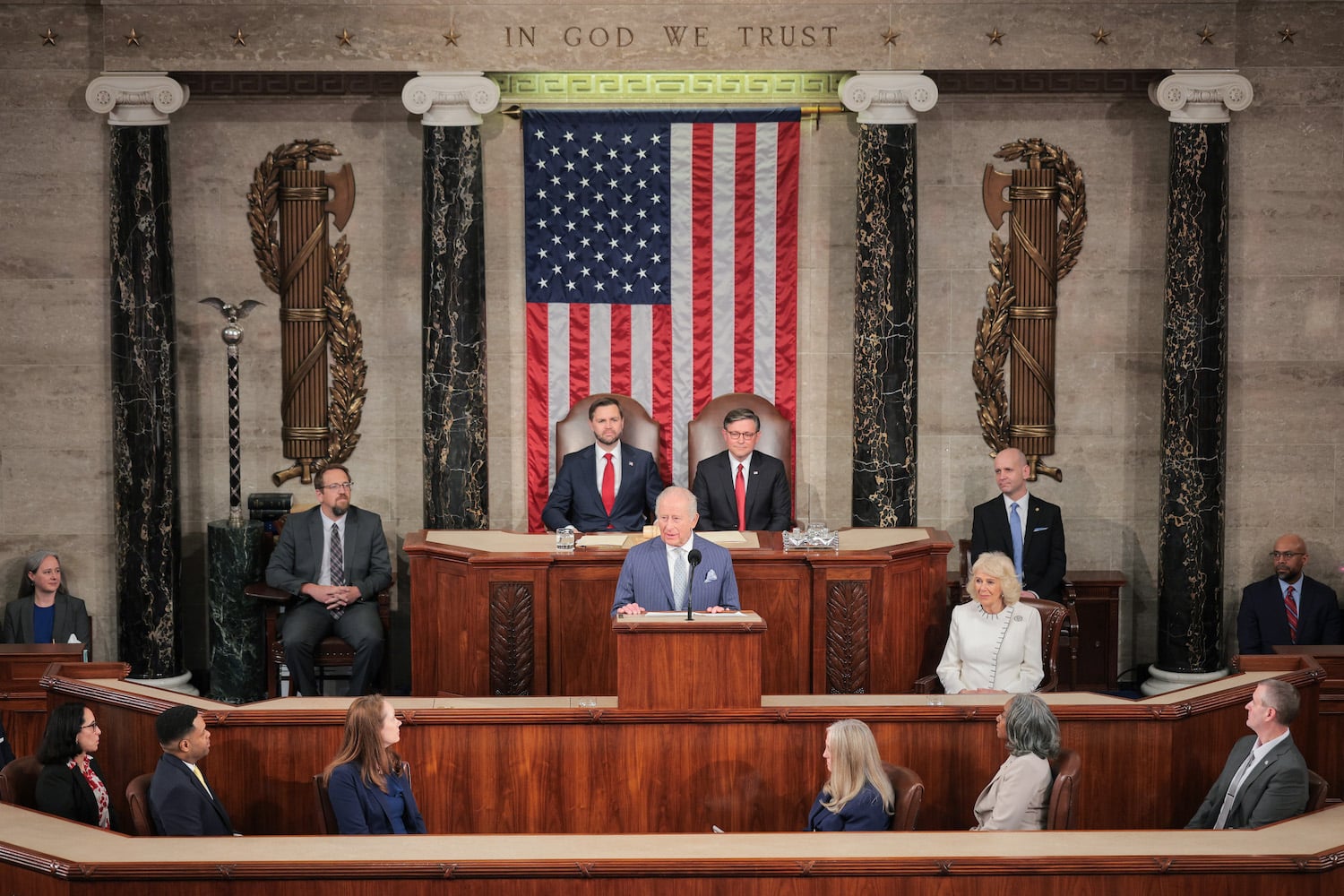
King Charles III became the second British monarch on Tuesday to address a joint session of the U.S. Congress. As London’s symbolic figurehead, Charles could have stuck with the status quo: delivering a tame, charming speech that avoided ruffling Washington’s feathers. Instead, the king issued a pointed 30-minute declaration that included several thinly veiled messages for the Trump administration.
From heralding the importance of multilateral institutions to warning against the threat of global warming, Charles repeatedly expressed views that are anathema in President Donald Trump’s White House. His fierce (and oftentimes witty) speech is likely to anger some in the Beltway—and perhaps even those in London, where several British lawmakers had hoped that Charles would use his unique position to soothe tensions between Trump and British Prime Minister Keir Starmer.
Here’s the full transcript of Charles’s speech:
Vice President, Mr. Speaker, members of Congress, representatives of the American people across all states, territories, cities, and communities. I would like to take this opportunity to express my particular gratitude for the great honor of addressing this joint meeting of Congress and, on behalf of the queen and myself, to thank the American people for welcoming us to the United States to mark this semiquincentennial year of the Declaration of Independence.
And for all of that time, our destinies as nations have been interlinked. As Oscar Wilde said, “We have really everything in common with America nowadays, except, of course, language.”
So, ladies and gentlemen, we meet in times of great uncertainty, in times of conflict from Europe to the Middle East, which pose immense challenges for the international community and whose impact is felt in communities the length and breadth of our own countries. We meet too in the aftermath of the incident, not far from this great building, that sought to harm the leadership of your nation and to foment wider fear and discord. Let me say, with unshakable resolve, such acts of violence will never succeed.
Whatever our differences, whatever disagreements we may have, we stand united in our commitment to uphold democracy, to protect all our people from harm, and to salute the courage of those who daily risk their lives in the service of our countries.
Standing here today, it is hard not to feel the weight of history on my shoulder because the modern relationship between our two nations and our own peoples spans not merely 250 years but over four centuries. It is extraordinary to think that I am the 19th in our line of sovereigns to study with daily attention the affairs of America. So I come here today with the highest respect for the United States Congress, this citadel of democracy, created to represent the voice of all American people, to advance sacred rights and freedoms. Speaking in this renowned chamber of debate and deliberation, I cannot help but think of my late mother, Queen Elizabeth, who in 1991 was also afforded this signal honor and similarly spoke under the watchful eye of the Statue of Freedom above us.
Today, I am here on this great occasion in the life of our nations to express the highest regard and friendship of the British people to the people of the United States. Now, as you may know, when I address my own Parliament at Westminster, we still follow an age-old tradition and take a member of Parliament hostage, holding him or her at Buckingham Palace until I am safely returned. These days, we look after our guests rather well, to the point that they often do not want to leave. I don’t know, Mr. Speaker, if there are any volunteers for that role here today.
As I look back across the centuries, Mr. Speaker, there emerge certain patterns, certain self-evident truths from which we can learn and draw mutual strength. With the spirit of 1776 in our minds, we can perhaps agree that we do not always agree, at least in the first instance. Indeed, the very principle on which your Congress was founded—no taxation without representation—was at once a fundamental disagreement between us and, at the same time, a shared democratic value which you inherited from us. Ours is a partnership born out of dispute but no less strong for it. So perhaps in this example we can discern that our nations are in fact instinctively like-minded—a product of the common democratic, legal, and social traditions in which our governance is rooted to this day.
Drawing on these values and traditions time and again, our two countries have always found ways to come together. And, by Jove, Mr. Speaker, when we have found that way to agree, what great change is brought about, not just for the benefit of our peoples but of all peoples. This, I believe, is the special ingredient in our relationship.
As President Trump himself observed during his state visit to Britain last autumn, the bond of kinship and identity between America and the United Kingdom is priceless and eternal. It is irreplaceable and unbreakable.
Mr. Speaker, this is by no means my first visit to Washington, D.C., the capital of this great republic. This is, in fact, my 20th visit to the United States and my first as king and head of the Commonwealth. This is a city which symbolizes a period in our shared history, or what Charles Dickens might have called “A Tale of Two Georges”: the first president, George Washington, and my five-times-great-grandfather, King George III. King George, as you know, never set foot in America, and please rest assured, ladies and gentlemen, I am not here as part of some cunning rear guard action.
The Founding Fathers were bold and imaginative rebels with a cause; 250 years ago—or as we say in the United Kingdom, “just the other day”—they declared independence by balancing contending forces. And drawing strength to diversity, they united 13 disparate colonies to forge a nation on the revolutionary idea of life, liberty, and the pursuit of happiness.
They carried with them, and carried forward, the great inheritance of the British Enlightenment as well as the ideals which had an even deeper history in English common law and Magna Carta. These roots run deep, and they are still vital. Our Declaration of Rights of 1689 was not only the foundation of our constitutional monarchy but also provided the source of so many of the principles reiterated, often verbatim, in the American Bill of Rights of 1791. And those roots go even further back in history. The U.S. Supreme Court Historical Society has calculated that Magna Carta is cited in at least 160 Supreme Court cases since 1789, not least as the foundation of the principle that executive power is subject to checks and balances.
This is the reason why there stands a stone by the River Thames at Runnymede, where Magna Carta was signed in the year 1215. This stone records that an acre of that ancient and historic site was given to the United States of America by the people of the United Kingdom to symbolize our shared resolve in support of liberty and in memory of (U.S.) President John F. Kennedy.
Distinguished members of the 119th Congress, it is here, in these very halls, that this spirit of liberty and the promise of America’s founders is present in every session and every vote cast—not by the will of one but by the deliberation of many representing the living mosaic of the United States. In both of our countries, it is the very fact of our vibrant, diverse, and free societies that gives us our collective strength—including to support victims of some of the ills that so tragically exist in both of our societies today.
And, Mr. Speaker, for many here and for myself, the Christian faith is a firm anchor and daily inspiration that guides us, not only personally but together as members of our community. Having devoted a large part of my life to interfaith relationships and greater understanding, it is that faith in the triumph of light over darkness which I have found confirmed countless times; through it, I am inspired by the profound respect that develops as people of different faiths grow in their understanding of each other. It is why it is my hope, my prayer, that in these turbulent times, working together and with our international partners, we can stem the beating of ploughshares into swords.
I am mindful that we are still in the season of Easter, the season that most strengthens my hope. It is why I believe with all my heart that the essence of our two nations is a generosity of spirit and a duty to foster compassion, to promote peace, to deepen mutual understanding, and to value all people of all faiths and of none.
The alliance that our two nations have built over the centuries, and to which we are profoundly grateful to the American people, is truly unique, and that alliance is part of what (former U.S. Secretary of State) Henry Kissinger described as “Kennedy’s soaring vision” of an Atlantic partnership based on twin pillars: Europe and America. That partnership, I believe, Mr. Speaker, is more important today than it has ever been.
The first reigning British sovereign to set foot in America was my grandfather, King George VI. He visited in 1939 with my beloved grandmother, Queen Elizabeth, the queen mother. The forces of fascism in Europe were on the march, and some time before the United States had joined us in the defense of freedom, our shared values prevailed. Today, we find ourselves in a new era, but those values remain. It is an era that is, in many ways, more volatile and more dangerous than the world to which my late mother spoke in this chamber in 1991.
The challenges we face are too great for any one nation to bear alone. But in this unpredictable environment, our alliance cannot rest on past achievements or assume that foundational principles simply endure. As my prime minister said last month: “Ours is an indispensable partnership. We must not disregard everything that has sustained us for the last 80 years. Instead, we must build on it.”
Renewal today starts with security. The United Kingdom recognizes that the threats we face demand a transformation in British defense. That is why our country, in order to be fit for the future, has committed to the biggest sustained increase in defense spending since the Cold War—during part of which, over 50 years ago, I served with immense pride in the Royal Navy, following in the naval footsteps of my father, Prince Philip, duke of Edinburgh; my grandfather, King George VI; my great uncle, Lord Mountbatten; and my great-grandfather, King George V.
This year, of course, also marks the 25th anniversary of 9/11. This atrocity was a defining moment for America, and your pain and shock were felt around the whole world. During my visit to New York, my wife and I will again pay our respects to the victims, the families, and the bravery shown in the face of terrible loss. We stood with you then. And we stand with you now in solemn remembrance of a day that shall never be forgotten.
In the immediate aftermath of 9/11, when NATO invoked Article 5 for the first time and the United Nations Security Council was united in the face of terror, we answered the call together—as our people have done so for more than a century, shoulder to shoulder, through two world wars, the Cold War, Afghanistan, and moments that have defined our shared security.
Today, Mr. Speaker, that same, unyielding resolve is needed for the defense of Ukraine and her most courageous people. It is needed in order to secure a truly just and lasting peace. From the depths of the Atlantic to the disastrously melting ice caps of the Arctic, the commitment and expertise of the United States armed forces and its allies lie at the heart of NATO, pledged to each other’s defense, protecting our citizens and interests, keeping North Americans and Europeans safe from our common adversaries.
Our defense, intelligence, and security ties are hardwired together through relationships measured not in years but in decades.
Today, thousands of U.S. service personnel, defense officials, and their families are stationed in the United Kingdom, as British personnel serve with equal pride across 30 American states. We are building F-35s together. And we have agreed to the most ambitious submarine program in history, AUKUS, and we are doing it in partnership with Australia, a country of which I am also immensely proud to serve as sovereign.
We do not embark on these remarkable endeavors together out of sentiment. We do so because they build greater shared resilience for the future, so making our citizens safer for generations to come.
Our common ideals were not only crucial for liberty and equality; they are also the foundation of our shared prosperity. The rule of law: the certainty of stable and accessible rules, an independent judiciary resolving disputes and delivering impartial justice. These features created the conditions for centuries of unmatched economic growth in our two countries. This is why our governments are concluding new economic and technology agreements—to write the next chapter of our joint prosperity and ensure that British and American ingenuity continues to lead the world.
Our nations are combining talent and resources in the technologies of tomorrow: our new partnerships in nuclear fusion and quantum computing, and in AI and drug discovery, holding the promise of saving countless lives.
More broadly, we celebrate the $430 billion in annual trade that continues to grow, the $1.7 trillion in mutual investment that fuels that innovation, and the millions of jobs on both sides of the Atlantic supported across both economies. These are strong foundations on which to continue to build for generations yet unborn.
Our ties in education, research, and cultural exchange empower citizens and future leaders of both countries.
The Marshall Scholarship, named after the great Gen. George Marshall, and the association of which I am so proud to be patron are emblematic of the connection between our two countries. Since its founding, more than 2,300 scholarships have been awarded, opening doors for Americans from all walks of life to study at the United Kingdom’s leading universities.
So, as we look toward the next 250 years, we must also reflect on our shared responsibility to safeguard nature, our most precious and irreplaceable asset.
Millennia before our nations existed, before any border drawn, the mountains of Scotland and Appalachia were one—a single, continuous range, forged in the ancient collision of continents.
The natural wonders of the United States of America are indeed a unique asset, and generations of Americans have risen to this calling. Indigenous, political, and civic leaders, people in rural communities and cities alike, have all helped to protect and nurture what (former U.S.) President Theodore Roosevelt called “the glorious heritage” of this land’s extraordinary natural splendor, on which so much of its prosperity has always depended.
Yet even as we celebrate the beauty that surrounds us, our generation must decide how to address the collapse of critical natural systems, which threatens far more than the harmony and essential diversity of nature. We ignore at our peril the fact that these natural systems—in other words, nature’s own economy—provide the foundation for our prosperity and our national security.
The story of the United Kingdom and the United States is, at its heart, a story of reconciliation, renewal, and remarkable partnership.
From the bitter divisions of 250 years ago, we forged a friendship that has grown into one of the most consequential alliances in human history. I pray with all my heart that our alliance will continue to defend our shared values—with our partners in Europe and the Commonwealth and across the world—and that we ignore the clarion calls to become ever more inward-looking.
Mr. Speaker, Mr. Vice President, distinguished ladies and gentlemen, America’s words carry weight and meaning, as they have since independence. The actions of this great nation matter even more. (Former U.S.) President (Abraham) Lincoln understood this so well, with his reflection in the magisterial Gettysburg Address that the world may little note what we say but will never forget what we do. And so, to the United States of America, on your 250th birthday, let our two countries rededicate ourselves to each other in the selfless service of our peoples and of all the peoples of the world.
God bless the United States, and God bless the United Kingdom.